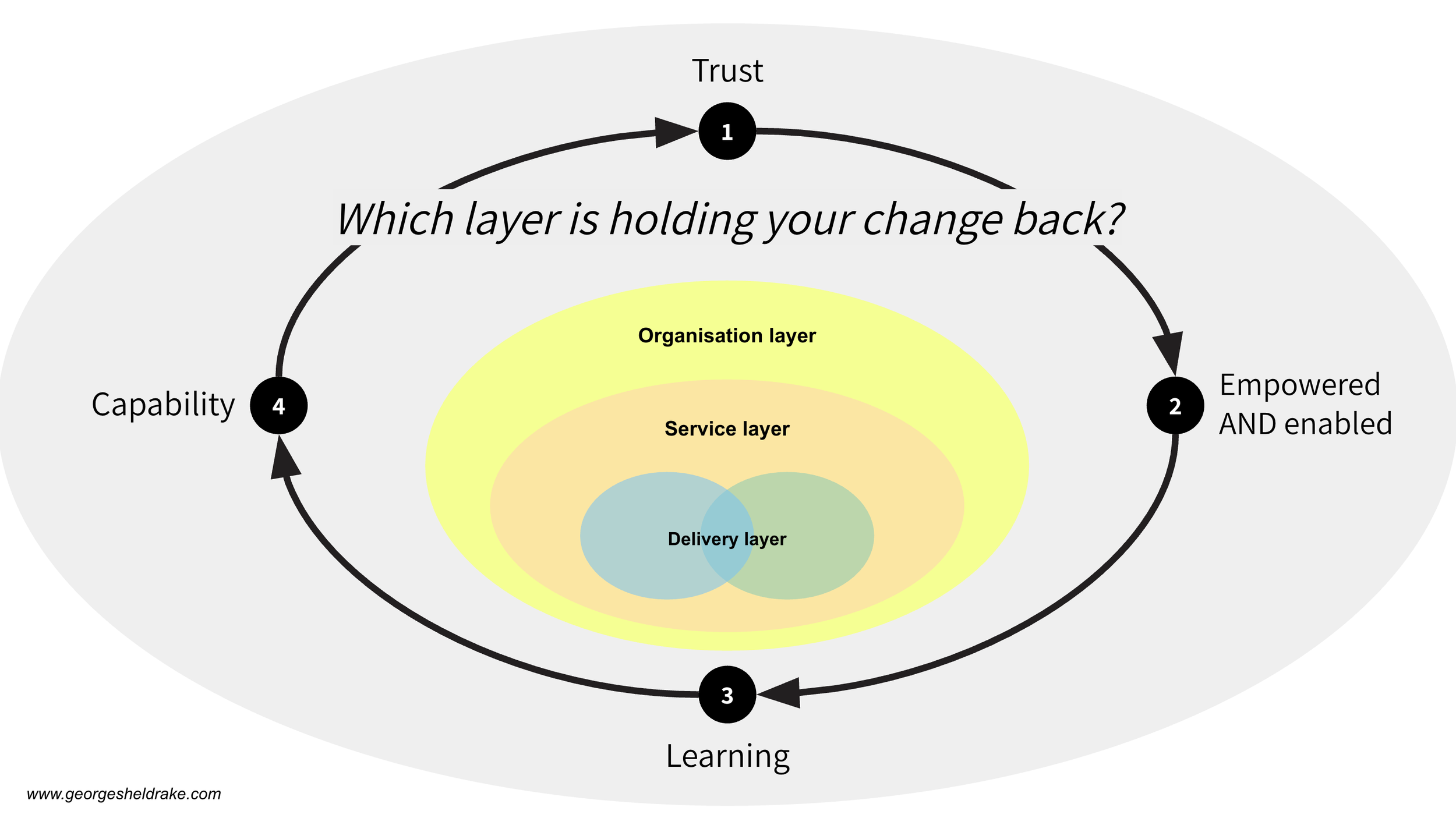
In my experience, change rarely fails on day one. Instead, the old ways of working slowly take back what the new ones won. Across three books, I found eight themes that show what it takes to make change stick.
This is the third post in a series of six. The first, ‘Alone, the product operating model is not enough’, and the second, ‘Delivery, Service and Organisation: what each layer means and why it matters’ looked at why change needs more than a new operating model, and why it has to work across layers. This post and the next two use themes from the authors to reflect on the conditions needed for change to last. The final post looks at what AI changes.
As before, I drew on Marty Cagan's Transformed (2024) for the product delivery layer, Kate Tarling's The Service Organization (2023) for the service layer and Adam Maddison's The Intelligence Era Organisation (2026) for the organisation layer. In this post I introduce the eight themes, show how they connect, and share a bit about how I worked.
Why read them together
All three authors align on many of the same themes about how to make change happen, and each backs their ideas with practical advice and real case studies. Each sees their own layer clearly but treats the others as background. Read side by side, they show where the layers depend on each other. That space in between is where I have often worked, looking at how policy and business intent meet implementation and delivery practice, or in many cases do not.
Because Cagan goes deepest at the delivery level, the series leans towards digital. In future I hope to add more on operational practice. It’s a space where similar work is being done in the physical world.
What they share: eight themes in two groups
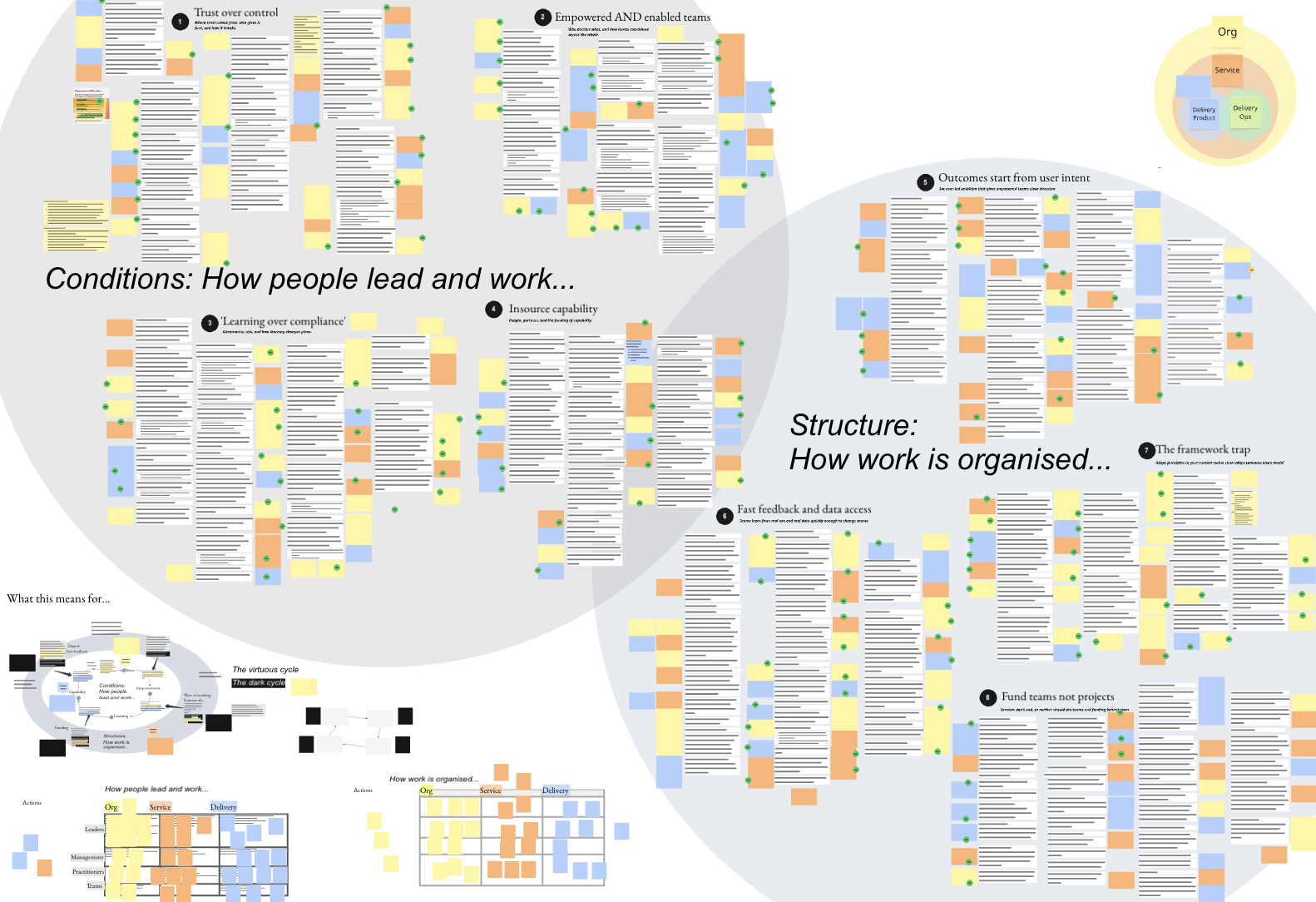
As I worked on the previous two posts, I noticed themes reappearing across all three books, each with the author’s own flavour. This series brings those ideas together into eight themes. Just a caveat here, the themes are my own synthesis, bringing the authors together to show how change from product teams up to organisation design is connected, and depends on action from leaders as well as teams.
I have put these into two theme groups, those that cover the conditions around how people lead and work and those that cover the structures we use to do the work. Essentially people and processes, if you want to get reductive about it.
Structure themes: how work is organised
5. Outcomes start from user intent. Teams are given outcomes based on what users are trying to do, rather than outputs to deliver.
6. Fast feedback and data access. Teams get regular feedback and the data they need, so learning reaches the people who can act on it.
7. The framework trap. Principles and guidance support team decisions, while frameworks push towards compliance.
8. Fund teams, not projects. Lasting funding for durable teams keeps what is learnt inside the organisation.
Condition themes: how people lead and work
1. Trust over control. The organisation runs on trust, with checks that support people rather than replace that trust.
2. Empowered AND enabled teams. Teams decide how to solve the problems they are given, with the support to deliver.
3. Learning over compliance. Governance manages risk through learning, and plans change with the evidence.
4. Insource capability. Organisations build and keep their own skills, and use partners to grow them
How the themes connect
Maddison describes how building trust in the service of experimentation creates “a virtuous cycle - where the presence of trust enables them to experiment, and the practice of promoting experimentation strengthens that trust” (pp. 73–74). Peter Senge’s The Fifth Discipline (2006) explains why cycles like this matter. He argues that people tend to see things in straight lines of cause and effect when in fact reality is circular (pp. 73–75), and that by “tracing the flows of influence” you can see “patterns that repeat themselves time after time, making situations better or worse” (p. 75). Senge frames these patterns as reinforcing loops, which can be “engines of growth” or drive “accelerating decline”, and balancing loops, which move you towards a goal (p. 79). He separates “detail complexity”, the kind most people recognise, from “dynamic complexity”, where “cause and effect are not closely related in time and space” (p. 63).
Basically, if we look at this work through Senge’s systems lens, most change programmes tackle the details, with more process, more plans and new frameworks, while the problems that matter sit in the ‘dynamics’. These have patterns, reinforcing and balancing, that are deeply embedded in how an organisation behaves, and they just will not change unless you make bigger, longer-term changes to the system.
That is why change that does not reach the organisation can look like it is working. The effects of what has not changed arrive much later, far from where they started. As Senge says of delays, “In the short term, you can often ignore them; they are inconsequential. They only come back to haunt you in the long term” (p. 91).
My point is that all eight themes are connected, dynamically and over time. The four conditions form a loop, where trust lets teams be empowered, empowered teams learn, learning builds capability, and capability earns more trust. The conditions drive the structures, and the structures hold the conditions in place. When the conditions are missing, the same links run in reverse, and the cycle turns backwards. Maddison argues the “legacy environment” is not passive but “actively configured to disincentivise change”, so that “every time a legacy process blocks a modern way of working, it creates a culture that makes people even more hesitant to try next time” (p. 42).
The "virtuous condition cycle” and the structures that help it to turn.
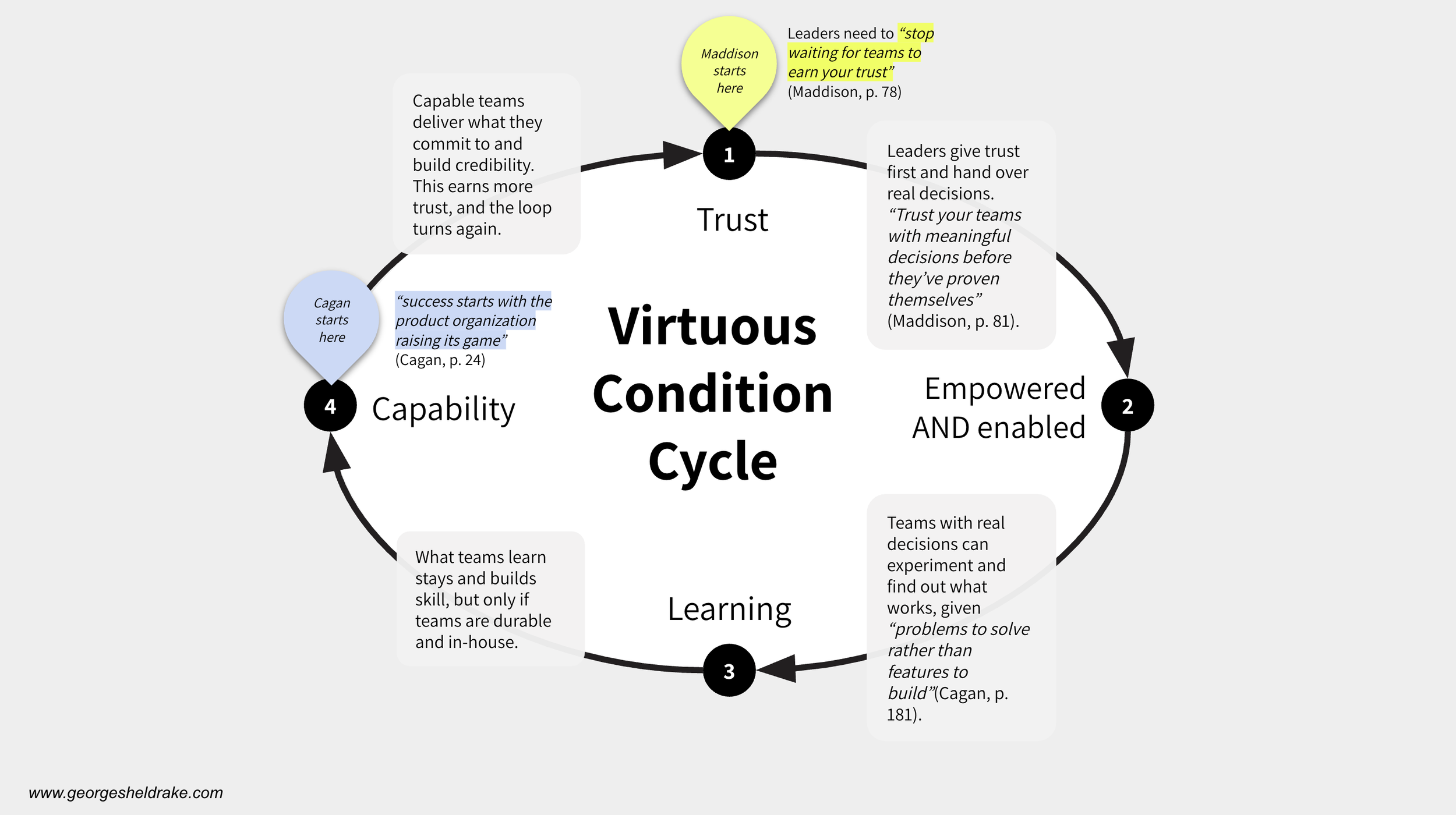
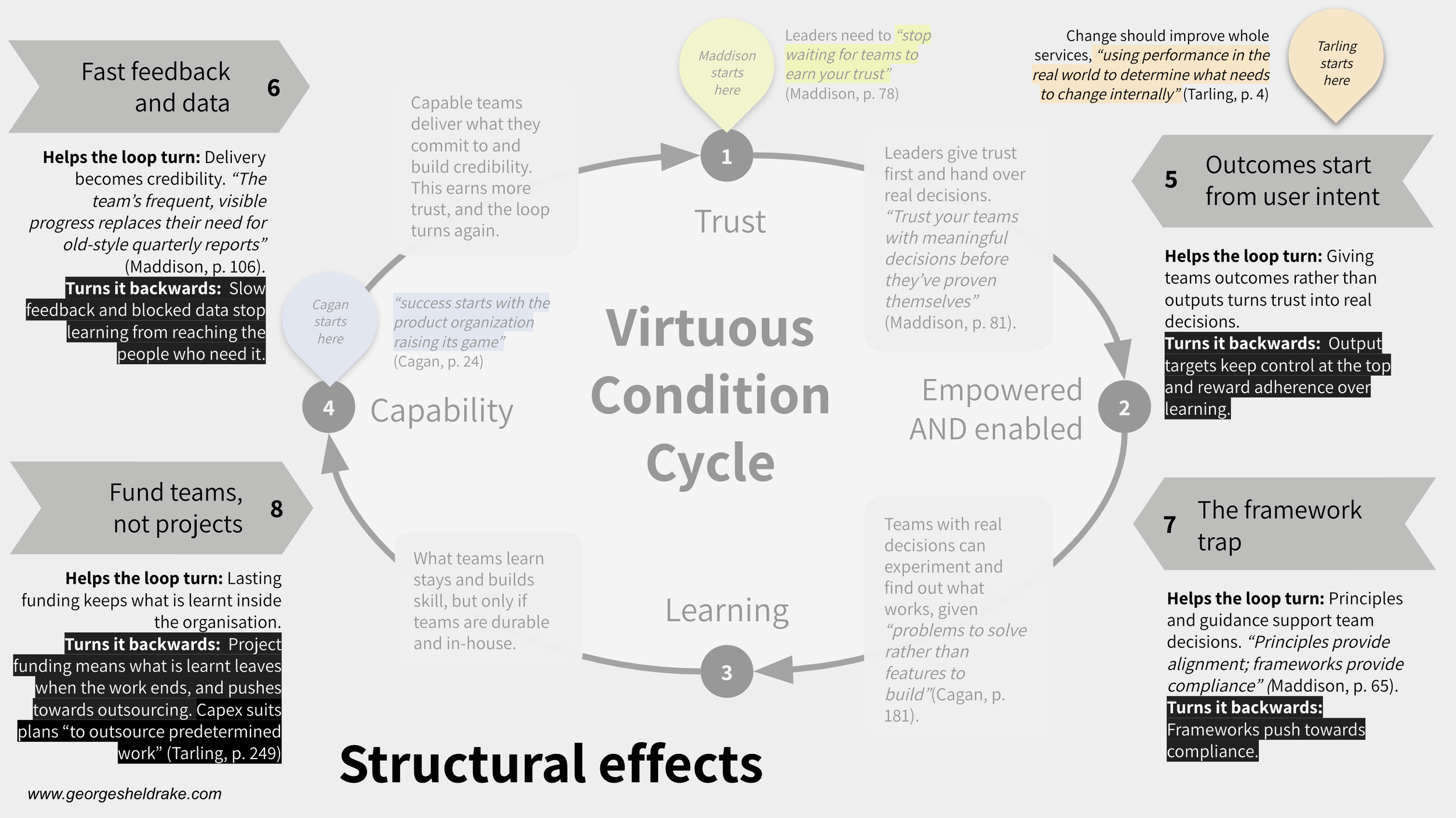
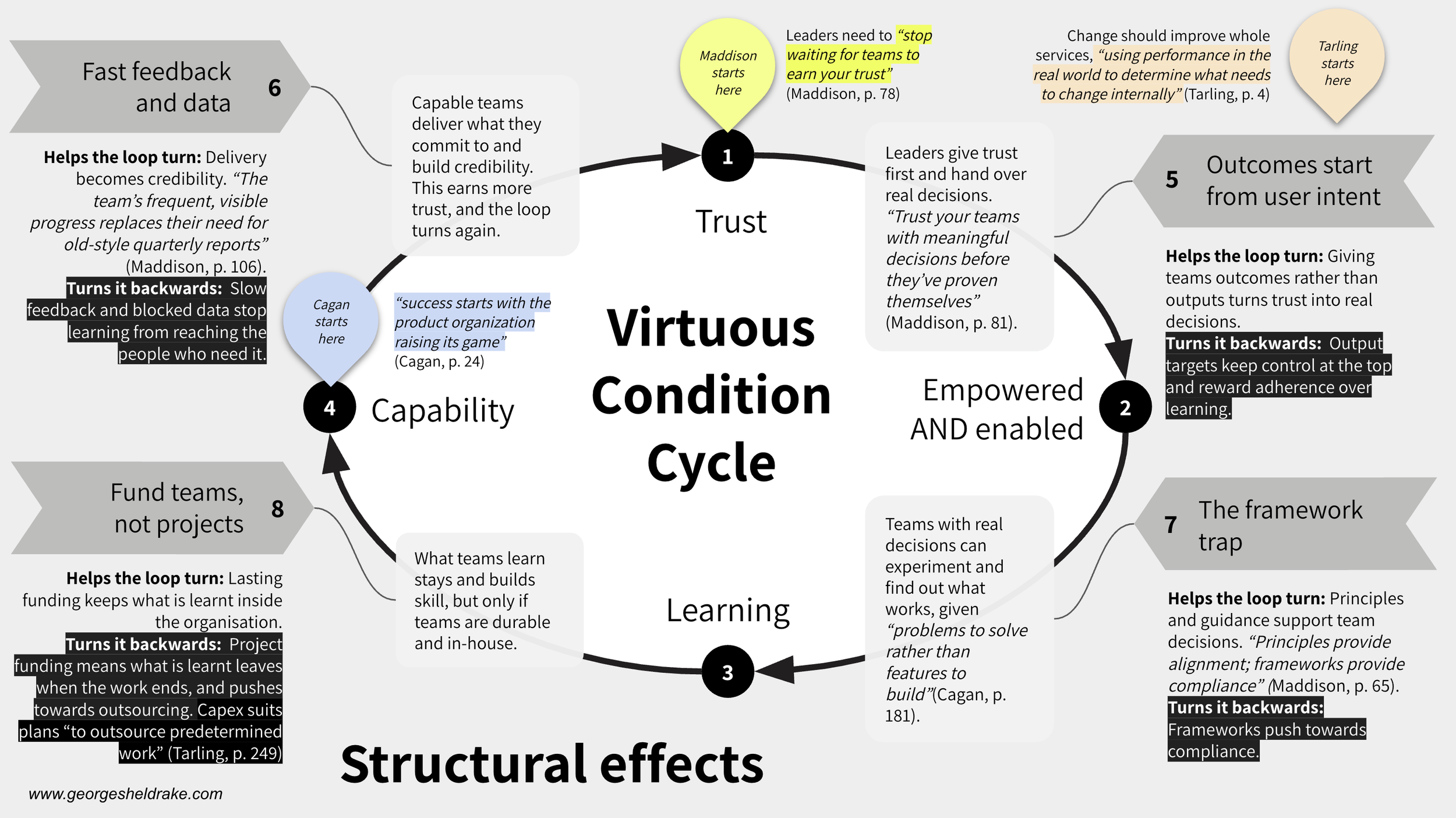
Each author enters the cycle at a different point. Maddison starts with trust, asking leaders to give it before it is earned (p. 78). Cagan starts with capability, putting the onus on product leaders to raise the skill of their people, because “you have as much ownership as you have credibility” (p. 24). Tarling starts from the outside in, using “performance in the real world” to decide what has to change inside the organisation (p. 4). In my experience, there is no single correct place to start, but wherever you start, the rest of the cycle has to follow.
With Senge in mind each layer (organisation, service and product) runs the cycle at its own speed, with its own actions and effects on the loop. Change that turns at product delivery but not at the organisation layer looks like it is working, then fades. Get the conditions right and the structures wrong, and you end up back where you started.
What to expect from my next two posts
Both posts follow the same shape, the sections all link together, so if you are short on time, start with the table and find your role.
The 8 themes. What each one means, what the authors say, and how it looks at the organisation, service and product delivery layers.
What is at risk. The risks brought together, and how the cycle can run in reverse.
How do you build it. Actions grouped into steps.
Who does this and why. The roles involved, with a table you can view by role or by action.
How I worked
This series started with one idea after some reading, and it has snowballed since. Some of it came from conversations with people about my thinking, and some from a quote or link I uncovered along the way. Overall, I have let it be an organic process, but once I decided to research the themes properly I needed to be more organised.
My background is in graphic design, and I have just been teaching visual communication at university, so I think in pictures. I used Miro boards to sort and test my ideas visually, as I would on any research project. The difference this time, compared with my master’s a few years ago, is that I shared my synthesis with Claude as I went. It helped me iterate and find patterns across the three books much faster than sorting by hand.
My working Miro board, with the conditions on the left, the structures on the right, and early sketches of the cycle and the role matrix at the bottom.
That does not mean it was quick, and at times I was working six days a week. The important part is staying in the driving seat. I have lost track of how many times I have said ‘that is incorrect’ and I have gone back to the paper books over and over. To work this way and still get the sources right, you need to be direct with your own opinion and be painstakingly methodical with the content you are using.
What's next
I will release the next two posts over the coming weeks. The final post, on AI, is still mostly bullets and links, so it may arrive after the festive season.
After all this time at my desk, I still think how we consider the different layers of change matters to everything we do. Whether you are a developer or designer in a product team, a leader, a board member or a frontline operations manager, it is worth reflecting on the conditions around you and the effect they have on what you are trying to do. Sometimes you can act on them, and sometimes it is time to look for a new job.
References
Cagan, M. et al. (2024) Transformed: Moving to the Product Operating Model. Wiley.
Maddison, A. (2026)The Intelligence Era Organisation: Creating the Conditions to Thrive in the Age of AI. Public Digital.
Senge, P. M. (2006) The Fifth Discipline: The Art and Practice of the Learning Organization. Cornerstone Press. Reprinted 2025.
Tarling, K. (2023) The Service Organization: How to Deliver and Lead Successful Services, Sustainably. London Publishing Partnership.
The theme names ‘Trust over control’ (Maddison, p. 188; Cagan, p. 116) and ‘Learning over compliance’ (Maddison, p. 188) come from the authors. All page numbers are from the editions I read.
