How to understand ‘services’ as a tool for your whole organisation
‘Service’ is one of those words that means different things to different people. Within most organisations, that ambiguity causes real problems.
Teams talk past each other. Design work gets scoped too narrowly. Whole parts of the user journey get left without an owner. One way to cut through this is to stop trying to define what a service ‘is’ and start describing what it does — specifically, the qualities that define its shape and position within a wider system.
The importance of ‘service’ qualities
Service qualities define what a service is. Think of them as a set of tags that are unique to the service in question. As a collection of descriptors, they help to define what the service is, how it works, who it's for and why. Without these, people from different business areas or professions are unlikely to share the same understanding of what 'service' means and will almost certainly have something different in mind. These service ‘qualities’ tell you far more than the label ‘service’ ever will.
Not all service journeys have an end
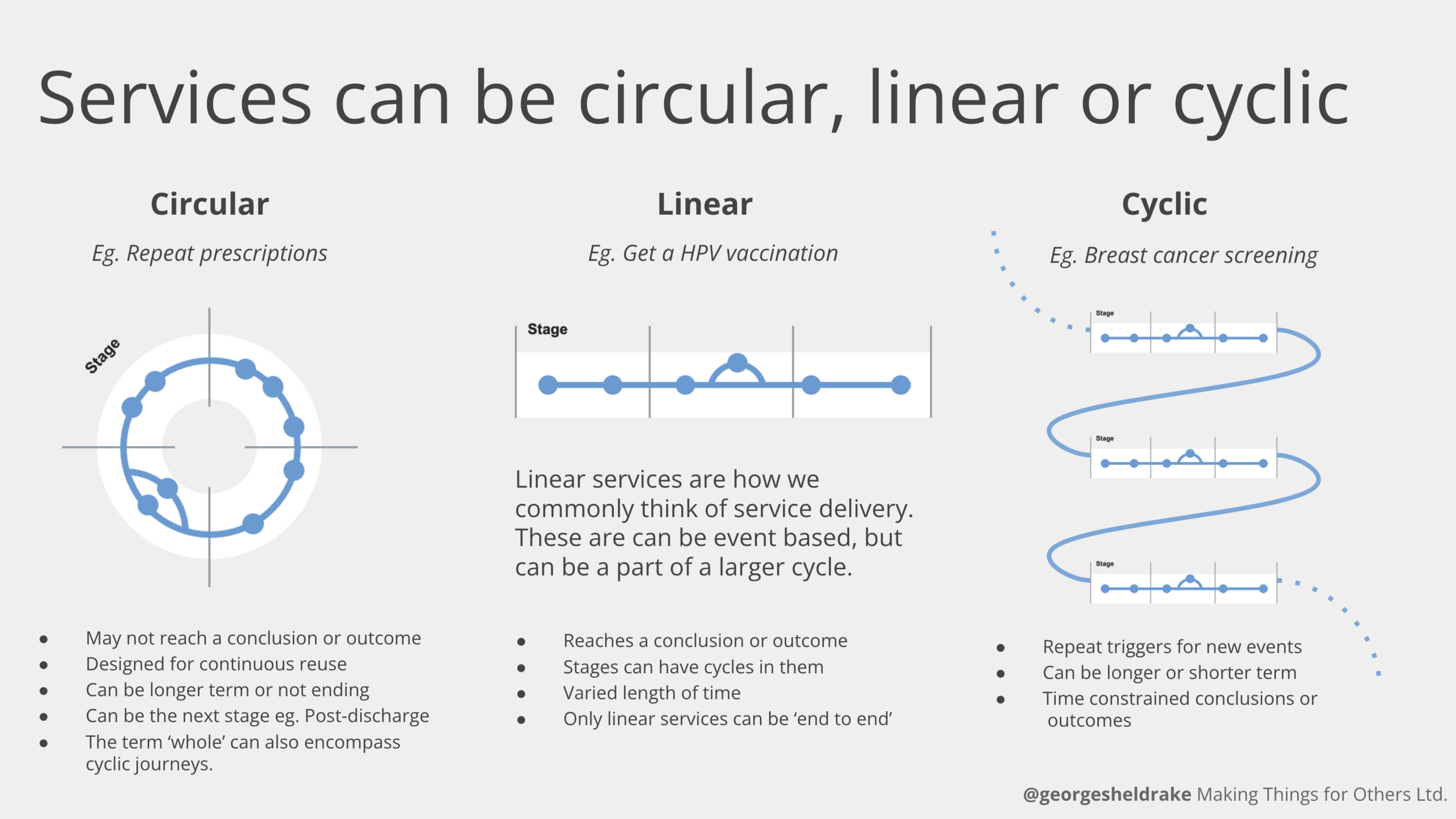
Services are commonly described as 'end to end', implying a clear start, a clear finish, and a linear path between them, but many services don't work that way. Some are cyclic, used repeatedly by the same person over time. Some are ongoing relationships, particularly in healthcare, where a person may be in continuous contact with a service over years or a lifetime. Using 'end-to-end' as a default framing risks designing only for the linear case, and leaving everything else underserved. A more useful term is 'whole service': it's inclusive of the different shapes a journey might take without implying a structure that may not exist.
Services can take different shapes and positions
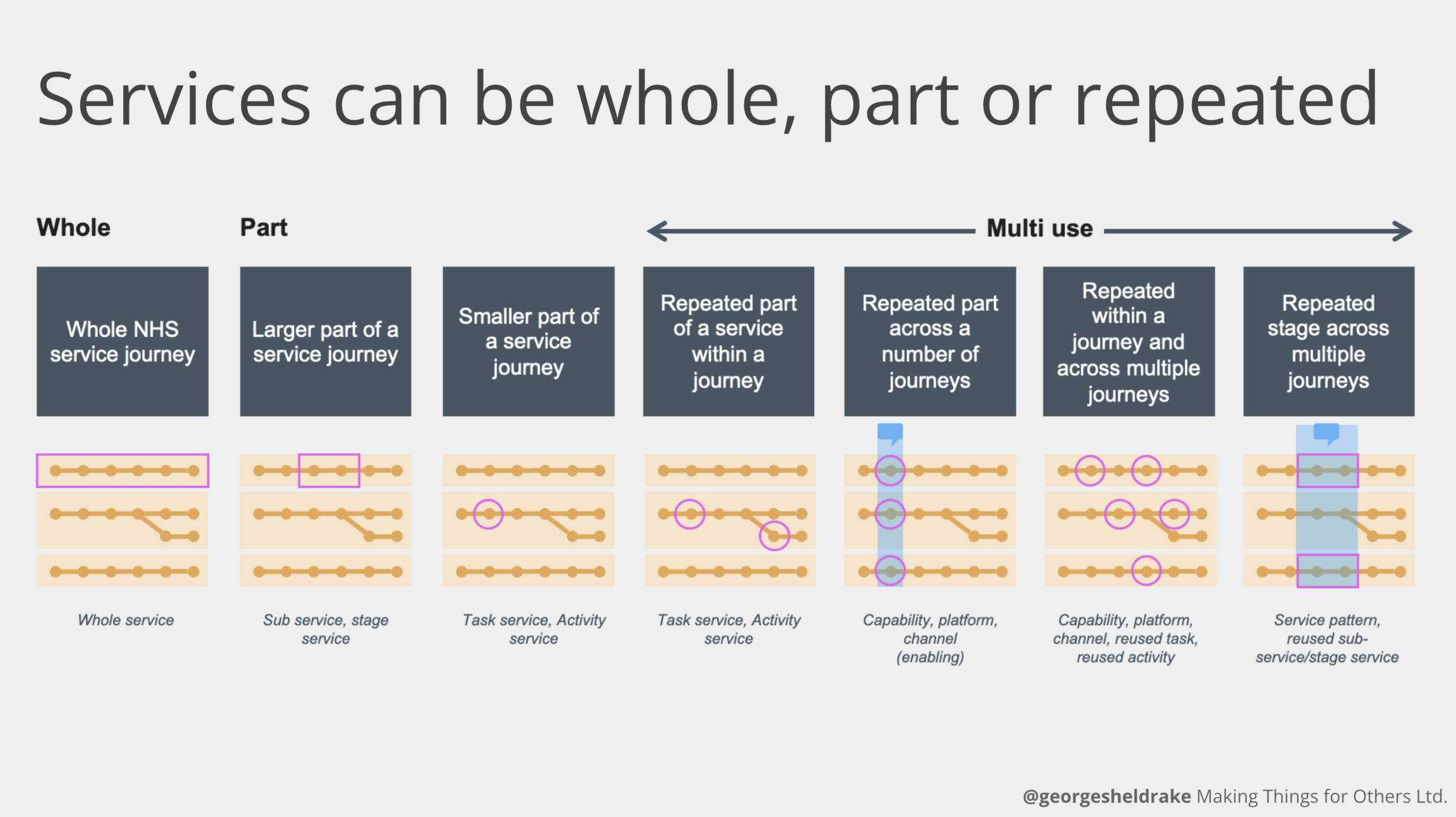
Using the term ‘service’ doesn't define the type of service it is. It can be a whole journey or a part of it — a horizontal service running across an organisation, a cross-cutting vertical service, a stage or segment of tasks grouped together. These can also be ‘behind-the-scenes’ infrastructure (invisible to users but essential to delivery), or a customer-facing touchpoint at the heart of the experience.
Service quality is directly connected to organisational design
How a service is delivered is never separate from how the organisation delivering it is structured. Poor organisational practice surfaces directly in service delivery. Tensions between teams become visible as broken handoffs and integration failures within the user journey. A transition from physical to digital, for example, often exposes where organisational structures are poorly aligned or failing to communicate. It's important that the wider context of a service and its intended outcomes are understood as a connected offer, from frontline operations to digital products and backend platforms. ‘Whole service’ success requires connected strategic intent and consistent delivery across all of those parts.
Standardisation and modularity are important tools for managing complexity
In large organisations with multiple services, delivery can quickly become unwieldy — varied in quality, costly to maintain and difficult to improve. Organisations need to find effective ways to reduce costly bespoke variance through consolidation and create quality standards that align with strategic intent. A systems approach that utilises standards, modularity and reuse reduces complexity and operational burden. It improves consistency and lowers cost.
From service mapping to organisational analysis
These frameworks have evolved considerably since their origins in 2014. What began as a way of describing individual service journeys has since been applied at an organisational level, mapping how entire organisations structure their delivery against their strategic intent.
One example is the work I led at the Government Digital Service (GDS) in the UK: a strategic review of how GDS's enabling functions, organisational structure and digital service delivery connected to its wider purpose. The service qualities framework informed how we mapped GDS's diverse digital offer, from GOV.UK to digital identity and payment platforms, against the operational and structural conditions needed to deliver them effectively. (You can read more about this work in my GDS case study.)
On reflection
Thinking about services in terms of their qualities, rather than trying to pin down a single definition, gives teams a more honest and flexible way to describe what they're working on. It reduces the ambiguity that causes misalignment, makes integration points more visible, and creates space to identify where services can be simplified, consolidated, or reused.
Most organisations already have the knowledge they need to do this; it sits with the people who deliver the service every day. The gap is rarely understood. It's a shared language and the organisational capability to act on it. Get these right, and the gap between how your services are designed and how they actually work stops being invisible.
——
If this resonates, it's worth reading alongside two related posts: How to define ‘service’ and Working services that aren't — and why they keep failing the people who use and deliver them
